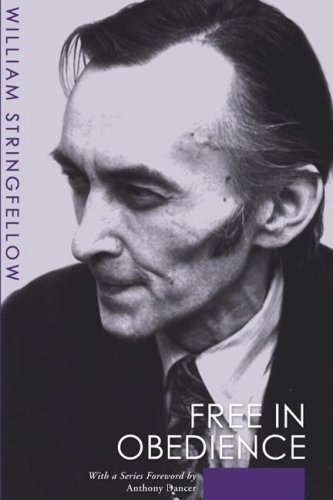
 I like how Anthony Dancer describes reading Stringfellow:
Despite the polemic and rhetoric, Stringfellow’s writing is neither a fanciful manual nor some early type of Google search engine for the Christian life. Instead he rewards sustained and quiet engagement, offering us an ethic that is at once simple but never easy; he reminds us of the need to be vulnerable to the world and God, and to be obedient to the call to authenticity just where we are. He reminds us of the politically and totally transformative significance of the fact that the reign of the power of Death is over, and that we are no longer bound by fear, but can once again live truly, and wondrously, in freedom. In short, he reminds us who and where, in the Word of God, we are called to be. (Free in Obedience, xiii).
Free in Obedience, which takes its theme from the Letter to the Hebrews, began life as a book for Lenten study. Importantly for his presentation, Stringfellow discerns no real distance between the original recipients of the letter and the church today – ‘the Christians today are the Hebrews’ (p. 7). And just like the original recipients,
The modern churches and the present-day Christians must, if they are to qualify to address and act in this world amid all the technologies, institutional powers, dehumanizing threats, frightful dangers of extermination, and ruthless idols which encompass men, trust the gospel. They must trust it enough to rely upon the discernment of those of the people of God who in preceding ages spoke and acted in their times and in the world as they knew it in the confidence that the Word which they heard and celebrated is the same Word present, uttered, and received in the world as it is now. (p. 8)
That ‘Christ is crucified in the freedom of the resurrection’ (p. 15) means that ‘the people and the things with which an ordinary Christian comes into contact from day to day are the primary and most profound issues of his faith and practice’ (p. 16). Stringfellow charges that the reason that moderns do not appear to pay attention to the Christian faith or to take the Church seriously is because churches have too often given men and women the impression that ‘they do not care about [people] or the world. They have misled [people] into supposing that the Christian faith has nothing to do with the ordinary issues of daily life’ (p. 18). They have, as Nathan Kerr too observes, missed the fact that God’s interruption of history in Jesus Christ is unintelligible apart from its operativity within the ongoing contingencies and complexities of history, that the lived embodiment of Christ’s lordship as a sign of the Spirit’s ongoing conversion of history to God’s coming reign involves, in the freedom of the missio dei, the creation of ecclesial witness to the centres of earthly power. And they have, Stringfellow insists, escaped the reality and decadence of the cities and ‘moved to the suburbs – only to find out that the same problem of the mission of the Church still plagues them, since the suburbs are satellites of the city’ (p. 20). Those who have remained in the city have been hiding out. Clearly, it is the missio ecclesiae for which this Harlem-based lawyer concerned about the immobility of the city’s poor confined to their ghettos – existing in ‘subjection to the principalities that rule the city’ (p. 24) – is troubled by here:
The rudiment of mission is knowledge of the city because the truth and grace of the Incarnation encompasses in God’s care all that is the city. Mission in the city for the Church, and hence for Christians, means a radical intimacy with every corner and every echelon of the city’s actual life in order to represent and honor God’s concern for each fragment of the city’ (p. 22)
Stringfellow suffers from no illusion that the modern cities which have emerged from industrialization and urbanisation are places neither of freedom nor of society. Rather than being cities of salvation, they are places where feudalism survives, kept alive by the propaganda machines of industrial and commercial powers, and by the moral theologies of Protestantism. ‘Medieval demons are not dead … They were not exorcised in the building of the city. They still exist there. The city is their present realm and their plunder’ (p. 26).
This is the situation that the Church must weigh accurately, and not suppress or flinch at, if it is to cease its blushing and turn towards the city in love that risks all reputation and possession. In order to do so, it must make the traumatic move of getting out bed with the heretical ideology of the industrial revolution (which supposes that we might save ourselves) and into bed with the gospel. Here Stringfellow is calling for ‘the renewal of the sacramental integrity of the churches’ (p. 29).
Don’t forget Wipf & Stock’s offer to readers of Per Crucem ad Lucem of 40% off the retail price of any of the Stringfellow volumes. To obtain the 40% discount, just include the coupon code STRINGFELLOW with your order.
 jasongoroncy.com
Stringfellow has always come out as a mystic for me, sometimes prophetic.. but always a mystic soul certainly. Myself, I cannot measure him biblically however.
LikeLike