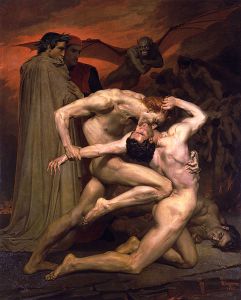
William-Adolphe Bouguereau, 'Dante And Virgil In Hell' (1850)
Some time ago I mentioned Nik Ansell’s superb study, The Annihilation of Hell: Universal Salvation and the Redemption of Time in the Eschatology of Jürgen Moltmann (Paternoster, forthcoming). Nik is professor of theology at the Institute for Christian Studies in Toronto. The Other Journal recently posted this piece wherein Nik picks up many of the themes in his forthcoming must read(!):
Abandon every hope, who enter here.
-Dante, Inferno, Canto III.9
Despite the Church’s curse, there is no one
so lost that the eternal love cannot
return-as long as hope shows something green
-Dante, Purgatorio, Canto III. 133-1351
If Hell is the nemesis of hope, can it be part of the Gospel? If Christ came to “free those who all their lives were held in slavery by their fear of death” (Heb. 2:15), should the fear of Hell keep the Church in business?2 If not, what on earth does “hell” mean in the New Testament?
Too hot to handle?
I’d like to explore these questions by first revisiting a controversy that came to a head twenty years ago concerning the theology of John Stott—a church leader who has been so influential and is so highly regarded worldwide that the New York Times recently referred to him as the “Pope” of Evangelicals.3
In 1988, David Edwards, an Anglican scholar long associated with the Student Christian Movement and SCM Press in the United Kingdom, published a respectful yet probing analysis of Stott’s theology entitled Essentials: A Liberal-Evangelical Dialogue. Predictably enough perhaps, one of Edwards’ sharpest challenges concerned the traditional doctrine of hell. Stott’s response, in the space he was given at the end of the relevant chapter,4 is now as famous as it is contentious. Forced to come clean about a topic he had largely avoided in his writings, he unambiguously rejected mainstream evangelical theology, declaring himself to be an “annihilationist.” While in traditional orthodoxy, the eternal souls of the saved and the damned experience either the blessing or the wrath of God forever, in Stott’s “conditional immortality,” the parallel (if not the contrast) is broken as those who fail to repent have no future in the age to come, thus passing out of existence. In the overcoming of evil, hell itself will pass away.5
Although reluctant to articulate his convictions in this area due to his concern for unity in the worldwide evangelical community, Stott nevertheless thanked Edwards for forcing the issue. He even went as far as to say of the traditional position, “[E]motionally, I find the concept intolerable and do not understand how people can live with it without either cauterizing their feelings or cracking under the strain.”6
Stott’s reluctance to write on the issue of hell and its annihilation because of the disunity it could create (or reveal) proved well founded. Soon afterward, at a major North American conference on what it meant to be an evangelical, the question was raised as to whether Stott himself should now be excluded given these recent revelations.7 It was put to a vote, and the motion was only narrowly defeated. The Pope was nearly excommunicated!
The Annihilationist Alternative
Annihilationism or conditional immortality has since been widely discussed and debated.8 If Stott’s theology is as representative here as it is elsewhere, then perhaps in another twenty years, this view of hell will no longer be confined to “open” evangelicals but may come to characterize the evangelical mainstream. Much will depend on whether there is widespread acceptance of Stott’s two-fold conviction that the Bible “points in the direction of annihilation” and that “‘eternal conscious torment’ is a tradition which has to yield to the supreme authority of Scripture.”9
Stott puts forward four main reasons for his position. Firstly, he proposes, we must take the biblical language of judgment-as-destruction far more seriously, and secondly, in the light of this extensive body of material,10 we must interpret the imagery of eternal fire far more carefully. In this context, Stott argues that fire’s main function “is not to cause pain, but to secure destruction, as all the world’s incinerators bear witness.”11 It is the fire that is eternal and unquenchable, Stott insists, not what is thrown into it. The smoke that “rises for ever and ever” (Rev. 14:11) is therefore to be seen as evidence that the fire has done its work. Eternal punishment, in other words, is not eternal punishing.
Stott claims that the “imagery” of hellfire, addressed in his second argument, is to be understood within the “language” of destruction, addressed in his first argument.12 His third and fourth arguments for annihilationism are similarly connected and concern the nature of justice as that is to be understood within God’s victory over evil.
Stott’s third point is that God’s justice is surely a justice in which “the penalty inflicted will be commensurate with the evil done.” Sin is indeed a grave matter, but in the traditional position there is a “serious disproportion,”13 in Stott’s judgment, between sins consciously committed in time and the torment that is to be consciously experienced throughout eternity as a result. Aware that traditional orthodoxy justifies everlasting punishment on the grounds that sinners will continue in their impenitence for ever, Stott develops his fourth point, which involves an appeal to those texts that are taken by some to point to a biblical vision of universal salvation. It is not that Stott wishes to defend universalism—far from it!14 But the biblical themes of God’s final victory over evil and his becoming “all in all” (1 Cor. 15:28) that are present in these texts,15 are incompatible, he insists, with the eternal existence of those who are damned and who would thus presumably continue to be in a state of rebellion against God.
Annihilationism, Stott proposes, solves these problems while doing justice to the biblical language about the judgment of the impenitent. His critics, however, accuse him of “special pleading” and of “playing fast and loose” with Scripture.16 The questions this controversy raises are still very much alive. Which position can claim biblical support? Which viewpoint should we endorse? With whom should we side: the annihilationists or the traditionalists?
The Last Word?
My own answer is: neither! Both positions, I suggest, must be rejected for at least two reasons, both of which call out for the development of a new theology in which Hell is no longer the nemesis of hope.
Firstly, both views allow evil to have the last word. As annihilationists have been quick to realize, the hell of traditional orthodoxy cannot do justice to the vision of Habakkuk 2:14 in which “the earth will be filled with the knowledge of the glory of the Lord as the waters cover the sea” or to the New Testament expression of this hope found in the promise that God will become “all in all” (1 Cor. 15:28). The traditional claim that the eternal suffering of the impenitent serves to glorify God by revealing his justice reduces the revelation of God’s glory to the restoration of God’s honor, thus separating the glory of God from the glorification of creation.17 Justice conceived as retribution closes down redemption and blocks the dawn of the age to come. In traditional eschatology, sinners no longer have the power to sin after the final judgment, yet they remain sinners. If they are to be everlastingly punished for the sins of the past, and for their impenitent condition, how is evil not still present in the world?18
Although the annihilationist attempt to find eschatological resolution beyond the confines of traditional orthodoxy is certainly justified, their own position has serious problems of its own. It is worth reminding ourselves, especially in this age of ecological violence and crisis, that the annihilation and destruction of God’s good creation is precisely the aim and goal of evil, not evidence of its defeat. The destruction, including the self-destruction, of those made in God’s image represents a victory for the forces of darkness. In the transformation of everlasting punishment into final judgment,19 evil still has the last word.
Secondly, I would like to suggest that both traditional orthodoxy and annihilationism seriously misread the Scriptures. There are fourteen references to “Hell” in the New Testament according to the New International Version (NIV), eleven of which refer to a place where human beings may end up as a result of God’s judgment. These eleven references all occur in the words of Jesus. Seven of the eleven are to be found in Matthew (5:22, 29, 30; 10:28; 18:9; 23:15, 33). The remaining four are all parallel texts: three in Mark (9:43-7) and one in Luke (12:5). These biblical references require closer attention than they have received in the current debate.
Gehenna
The Greek word for Hell in these texts is transliterated into English as Gehenna.20 In its earlier Hebrew form, Gehenna makes its debut in the Bible as a geographical place: the valley of (the son[s] of) Hinnom, or gê hinnōm (see Josh. 15:8, 18:16).21 According to archeologists, this is one of the valleys that is found close to the walls of Jerusalem.22
In Jeremiah 7:30-34, this valley is no longer seen as a piece of real estate that anyone would wish to own.23 Now it has become a place of judgment—an imminent judgment in history directed against Israel:
The people of Judah have done evil in my eyes, declares the Lord. They have set up their detestable idols in the house that bears my Name and have defiled it. They have built the high places of Topheth24 in the Valley of Ben Hinnom to burn their sons and daughters in the fire—something I did not command, nor did it enter my mind. So beware, the days are coming, declares the Lord, when people will no longer call it Topheth or the Valley of Ben Hinnom, but the Valley of Slaughter, for they will bury the dead in Topheth until there is no more room. Then the carcasses of the people will become food for the birds of the air and the beasts of the earth, and there will be no one to frighten them away. I will bring an end to the sounds of joy and gladness and to the voices of bride and bridegroom in the towns of Judah and the streets of Jerusalem, for the land will become desolate.
Similar language occurs in Jeremiah 19, where an imminent siege of Jerusalem is prophesied in response to Israel’s idolatry. The references to burning sons and daughters in the fire (see Jer. 7:31, 19:5, and 32:35) refer to atrocities associated with Judah’s kings Ahaz and Manasseh (2 Ki. 16:2-3, and 21:1-6). That such sacrifices were conducted in the Valley of Hinnom is made explicit in 2 Kings 23:10 and in the parallel account of their reigns found in 2 Chronicles 28:3 and 33:6.
The valley continues to be associated with idolatry and fire in the prophetic tradition, but now the fire is seen as coming from God. In Isaiah 30:33, God says:
Topheth has long been prepared; it has been made ready for the king [of Assyria, cf. v. 31].
Its fire pit has been made deep and wide, with an abundance of fire and wood;
the breath of the Lord, like a stream of burning sulfur, sets it ablaze.
In this imminent, historical judgment, we have fire and sulfur, or fire and brimstone, which harks back to the destruction of Sodom and Gomorrah (Gen. 19:24) and reappears in the book of Revelation (see Rev. 14:10, 19:20, 20:10, and 21:8).25
The same valley is also intended as the location for the judgment described in the final verse of the book of Isaiah. Thus, Isaiah 66:22–23 reads:
“From one New Moon to another and from one Sabbath to another, all mankind will come and bow down before me,” says the Lord. “And they will go out and look upon the dead bodies of those who rebelled against me; their worm will not die, nor will their fire be quenched, and they will be loathsome to all mankind.”
During the rise and fall of Jewish nationalism—a period that includes the Maccabean revolt against the Seleucids (169-160 BCE), the Great War against Rome (66-70 CE), and the revolt of Bar Kokhba, also against Rome (132-135 CE)—it is not hard to see how these passages from Isaiah, taken together with the portrayal of God’s judgment of the nations in Joel 3,26 could have fuelled the conviction that the dead bodies of Israel’s enemies should be cast into this Gehenna.27
Although a nationalistic agenda that would equate God’s enemies with Israel’s enemies is foreign to the prophetic tradition, it remains the case that for the Old Testament prophets, Gehenna is understood as the place where the wicked will be punished with fire in the “last days.” But as this is an earthly place outside Jerusalem and as the “last days” are clearly understood as taking place within history,28 this is very different from the Gehenna of later rabbinic literature in which the Valley of Hinnom has become an underworld or otherworldly realm that has been in existence since the creation.29 Such a place can indeed be identified with the Hell of traditional Christian theology. But these later Jewish texts all come from a time after the destruction of Jerusalem in AD 7030 when the Jewish worldview was thrown into crisis, to be recast by the rabbis into a far less geographically rooted form.31 By contrast, the Gehenna of the gospels, I suggest, continues the Old Testament tradition of imminent, this-worldly judgment.32
But there is a twist. Whereas his Jewish contemporaries saw Gehenna as the place where the nations in general and the Romans in particular would get what was coming to them,33 Jesus, standing in the tradition of Jeremiah, uses the language of the prophets to speak of God’s wrath against Jerusalem.34 Thus, in Mark 9:48, Jesus draws on the final verse of Isaiah, as cited above, to refer to a judgment that will soon fall not on the Romans as expected, but on his fellow Israelites:
And if your eye causes you to sin, pluck it out. It is better for you to enter the kingdom of God with one eye than to have two eyes and be thrown into [Gehenna], where “their worm will not die, nor will their fire be quenched.”
All of Jesus’s references to Gehenna, which are widely thought by believer and non-believer alike to refer to a last judgment at the end of time, are actually about the coming judgment on Israel, Jerusalem, and its temple. Here we should not be misled by the fact that Jesus’s language is apocalyptic in character. It is no coincidence that the last of the seven references to Gehenna in Matthew’s gospel (Mt. 23:33) is so close to the long discourse about the “end of the age” (Mt. 24:3 cf. Mt. 24:4-25:46). But to speak of this coming judgment of Jerusalem as “the end of the world,” thus using apocalyptic language for the events of history, is a way of speaking that is not as foreign to us as we might think. When we refer to certain events as “earth shattering,” for example, we know that there may be no literal geological upheavals or volcanic eruptions. But we also know that there are times when we need this kind of language if we are to even begin to capture the significance of what is happening. If we bear this language of cosmic upheaval in mind, then we can better understand the apocalyptic discourse that is found in Scripture.35
Contrary to popular belief, no Jew in Jesus’s day was expecting God to bring about the end of the space-time universe.36 But the destruction of the temple, which was built to symbolize the creation, thus revealing God’s presence within it,37 would be seen as truly cataclysmic. For Jesus, this was God’s judgment on Israel, signaling nothing less than what we might call the end of the old world order.38 The only appropriate language was the language of de-creation. This is precisely how Jeremiah speaks in his day of the coming destruction of Judah and the temple (Jer. 4:23-28). God’s judgment on Israel, carried out by the Romans, is acted out by Jesus in his ‘cleansing’ of the temple and his cursing of the fig-tree (see Mk. 11:12-25 and 13:28-31). In the coming destruction, he said, the Son of Man would be vindicated (see Mk. 1339). This judgment/vindication, which is described in terms of de-creation and enthronement, is also a main theme of the book of Revelation.40
The Jewish leaders and those who followed them were destined for Gehenna, said Jesus. In refusing to be a light to the Gentiles, in judging the world, and in preparing to engage in “holy” war against Rome, Israel had become like her Gentile oppressors, caught in idolatry. It is a grim fact of history that when the Romans laid siege to Jerusalem and the temple, culminating in its destruction, one generation later, the dead who were thrown from the city walls literally piled up in the Valley of Hinnom, Gehenna, Hell.41
In Jesus’s understanding, this was the “eternal” fire or destruction of God’s judgment (Mt. 18:8, 25:41, 25:46). When annihilationists claim that it is the punishment rather than the punishing that is everlasting, the argument is tenuous and tortured. But it is also unnecessary. The word translated as eternal here literally means “of the age (to come).”42 This is the judgment that ushers in the new age as foreseen by the prophets who looked forward to the end of the exile.43 According to the New Testament, God’s judgment on Israel at the hand of the Romans is a judgment that Jesus suffers on the cross so that his followers may avoid it. The destruction of the temple is the vindication of Jesus and his followers as the true Israel. It also marks God’s judgment on the enemies of this true Israel: a judgment that marks the birth pangs of a new world, heralding the true return from exile and the dawn of the new creation. Now, with the establishment of the people of God made up of Jews and Gentiles, God’s promise to Abraham—that he would have offspring as numerous as the stars—is finally coming true.44
The decisive victory against evil and thus against the idolatrous powers and principalities that humanity serves has been won on the cross, says Paul—a cross through which even the very powers and principalities that crucified Christ are reconciled to their Creator (see Col. 1:20ff.). In the power of the Spirit, the church is to live out this redemption, spreading the good news to the ends of the earth.
The future is far from dark. The non-human creation too will be healed and, according to the famous language of Romans 8, will experience a cosmic exodus and thus be set free from the oppression of our idolatry.45 Evil will be completely eradicated. As Paul puts it in 1 Corinthians 15: 24-25, 28:
For as in Adam all die, so in Christ all will be made alive. But each in his own turn: Christ, the firstfruits; then, when he comes, those who belong to him. Then the end will come, when he hands over the kingdom to God the Father after he has destroyed all dominion, authority and power. For he must reign until he has put all his enemies under his feet [. . . .] When he has done this, then the Son himself will be made subject to him who put everything under him, so that God may be all in all.
It is significant that here, in the most sustained discussion of the general resurrection in the New Testament, there is no mention of Hell, either as eternal torment or as annihilation. But this should come as no surprise, I suggest, as the Christian doctrine of Hell, for all the appeals to Scripture that have been made on its behalf, has no biblical basis.
Hell in History
Although Hell is foreign to the gospels, Gehenna is another matter—its significance for the church’s own history having been completely overlooked.
To briefly summarize the gospel setting in which the judgment of Gehenna is found, the Israel of Jesus’s day is consistently portrayed as failing to be a light to the Gentiles, its election being (mis)understood not as a calling to reveal God’s presence to the nations but as a sign that it is safe from the justice and wrath of God that would soon descend on the Gentile—and specifically Roman—world for its moral depravity and idolatrous ways.46 Far from sharing God’s love and wisdom, Israel’s leaders, according to the gospel writers, understood the way of holiness as purity from outside contamination.47 Yet the very different spirituality and holiness of Jesus is vindicated when the judgment that he prophesied and enacted against the temple comes to pass, marking the end of the old age (Mt. 24:3, 14) and the birth pangs (Mt. 24:7) of the age to come.
Generalizations have their limits, but a good generalization is generally true. More often than not, I suggest, the church has gone on to recapitulate the sins of Israel: calling God’s wrath down on sinners, setting itself “over” and “against” the world, hiding its true light under a bushel.48 The Roman Empire fell. Christendom was born. The Holy Roman Empire,49 as it came to be known, ruled the world, threatening all who would not toe the line with the fires of eternal torment.50 There is a place for nuanced historiography, but to those who were oppressed by the church when it was at the height of its powers, this would not be seen as a caricature. The secular critique of Christianity, for all its one-sidedness, is not without foundation.
There are two biblical patterns, I believe, that can help us interpret this history. The first is a complex, two-part motif found in the prophets, whereas the second is a pattern found throughout Scripture in which judgment is understood as related to salvation rather than to damnation.
This first biblical pattern, evident in Isaiah 10: 5-17, comes to the fore in the conviction that when God’s people fall into idolatry and fail to respond to the warnings of the prophets, they are handed over to their enemies who act out God’s wrath, to be judged in turn when God, responding out of his covenant love, judges Israel’s enemies for the way they have judged his people! In this light, and in the light of the judgment revealed against Israel in the synoptic apocalypse (Mt. 24/Mk. 13/Lk. 21), should we not ask ourselves whether history reveals God handing Christendom over to its enemies to face its hell, its Gehenna? If the Christian era came to an end with the dawn of the Enlightenment, which, in is secular form, attacked the church for its evils, not least for its cruel doctrine of Hell, then instead of condemning it, should we not, first and foremost, ask whether the dawn of the modern age can be seen as God’s judgment against the church? Even as we may also ask whether, given the violence with which modernity has dealt with people of faith, God has now handed modernity over to its postmodern critics.
Judgment unto Salvation
If we are open to God’s revelation in the secular critique of Christianity, it will not be hard to see that for too long, a church bent on control and motivated by fear has proclaimed that the good news amounts to avoiding the bad news. The self-critique of the prophetic tradition can further alert us to the fact that the church, if it is to avoid being thrown into Gehenna yet again, will need to jettison its doctrine of Hell and the mentality that goes with it and recapture how the Gospel is the good news of life lived to the full in covenant with God, without whom there is no life.51
That said, if we are to find a deeply biblical orientation to our own history, this way of understanding the significance of Gehenna—the way of self-critique— needs to be related to the second biblical pattern I have alluded to. Because justice conceived as retribution closes down redemption, we must be careful that we are not simply historicizing the traditional or annihilationist understanding of how God responds to evil. In a truly biblical redemptive-historical paradigm, I propose, judgment is not an end in itself and is therefore not final in that sense, but is always a judgment-unto-salvation.
This understanding of justice and judgment calls for a fundamental rereading of many biblical passages. Elsewhere I have explored this in relation to the book of Revelation.52 Here I will mention just one example that I think is paradigmatic for all of Scripture: the diversifying of the peoples and their ways of speaking that happens after the fall of Babel.53 In the light of God’s self-maledictory oath, after the flood, never to annihilate human life (Gen. 8:21, 9:11), it is important to see how the judgment of Babel is not a punishment, but a blessing that intends to get history back on track in line with the emergence of the nations that are described as “spread[ing] out over the earth” in Genesis 10:32 (cf. Gen. 10:5). Viewed within Genesis as a whole, the diversifying of the peoples that is highlighted in emphatic detail just before the Babel narrative (see Gen. 10:1-32) is seen as a positive response to the original benediction of Genesis 1:28 to “fill the earth,” even though this blessing, due to fear, is experienced as a threat in Genesis 11:4. What the judgment on Babel reveals is that the attempt to resist history is itself a dead end. It is a judgment-unto-salvation because the scattering allows the call to “fill the earth,” misconstrued in a fallen world as the word of death, to become once again the word of life.
The good news of Gehenna is that for those who have ears to hear and eyes to see, the attempt to invoke God’s judgment as an end in itself, as final, is revealed as a dead end. Such a spirituality does not belong to, and cannot be a part of, the life of the age to come. Thus, in looking back over church history at the rise and fall of the doctrine of Hell, we may be set free to develop an eschatology in which hope is allowed to triumph over fear.
Open Ended
Rather than close by spelling out what this means for our theologies, or by articulating a theological position as such, I would like to end with an open-ended image from the book of Revelation that is suggestive of a theology and a vision of the church that does not yet exist.
In the final chapters of John’s Apocalypse, we might expect to discover that the sinners who clearly do not escape the judgment that is described in language drawn from the fall of Jerusalem54 are either in the lake of fire or have now been annihilated by it. But instead, we actually find them outside the city (Rev. 22:15).55 Furthermore, this ‘exclusion’ is one that must be read in the light of the fact that there is still a mission to the nations (Rev. 21:24; 22:2). John’s vision reveals that because sin has no future in God’s world, the impure may not enter the city (Rev. 21:27). Yet this provides no ammunition for those who want to preach the final judgment of hellfire and damnation as “On no day will [the] gates [of the New Jerusalem] ever be shut” (Rev. 21:25).
Against the openness of God, the evil that would annihilate God’s creation, close down history, and shut the world off from its Creator, does not have a hope in hell.56
Notes
1.
The Divine Comedy Of Dante Alighieri, Inferno, A Verse Translation with an Introduction by Allen Mandelbaum (New York, NY: Quality Paperback Book Club, 1981), 20-21 and
The Divine Comedy Of Dante Alighieri, Purgatorio, A Verse Translation with an Introduction by Allen Mandelbaum (New York, NY: Quality Paperback Book Club, 1983), 26-27.
2. Because I am engaging with evangelical theology in particular in this essay, biblical quotations will be from the New International Version (NIV).
3. See David Brooks, “Who Is John Stott?” New York Times, November 30, 2004, available online at: http://www.nytimes.com/2004/11/30/opinion/30brooks.html?_r=1. Brooks cites Michael Cromartie of the Ethics and Public Policy Center as saying that “if evangelicals could elect a pope, Stott is the person they would likely choose.”
4. See “John Stott’s Response to Chapter 6,” in Essentials: A Liberal-Evangelical Dialogue, David L. Edwards with John Stott (London, UK: Hodder and Stoughton, 1988), 306-331.
5. Although Stott does refer to “annihilation,” (Essentials, 315, 318, 320), he seems to prefer to speak of “conditional immortality” (Essentials, 316). One of the merits of characterizing this position as “annihilationsim” is that it captures how those who remain in their sins come to nothing (Latin nihil) to the point where they are not even “history.” At the same time, it is important to note that for Stott, and for many others associated with this viewpoint, this is a misleading term because of what it could imply about God. A key tenet of Stott’s position, in distinction from traditional orthodoxy, is that the soul is not inherently immortal. Consequently, those who reject the gift of eternal life are seen as either foregoing resurrection altogether or as being left to pass out of existence after the final judgment. God, in other words, does not “actively” destroy them. This is a more fundamental departure from the God of traditional orthodoxy than annihilationism might be imply.
6. Stott, Essentials, 314.
7. The back cover of Essentials—hot off the press and on sale at the conference—introduced a summary of the dialogue to be found within its pages by posing the question: “What beliefs define an evangelical?” For an account of the Evangelical Affirmations consultation, see Walter Unger, “Focusing the Evangelical Vision” in Direction 20, no. 1 (Spring 1991): 3-17, available online at: http://www.directionjournal.org/article/?692.
8. In Essentials, 320, Stott wrote, “I do not dogmatise about the position to which I have come. I hold it tentatively. But I do plead for frank dialogue among Evangelicals on the basis of Scripture.” For examples of the dialogue that Stott was hoping for, see William Crockett, ed., Four Views On Hell (Grand Rapids, MI: Zondervan, 1996) and Edward William Fudge and Robert A Peterson, Two Views of Hell: A Biblical and Theological Dialogue (Downers Grove, IL: InterVarsity Press, 2000). For additional evidence that annihilationism is increasingly perceived as a legitimate evangelical position, see David Hilborn, ed., The Nature Of Hell: A Report by the Evangelical Alliance’s Commission on Unity and Truth among Evangelicals (ACUTE) (Carlisle, UK: Acute/Paternoster Publishing, 2000). For an Anglican case for annihilationism that included but was not confined to evangelical input, see The Mystery Of Salvation: The Story of God’s Gift. A Report by the Doctrine Commission of the General Synod of the Church of England (London, UK: Church House Publishing, 1995), 198-199.
9 Stott, Essentials, 315. One might explore the question of the future of evangelicalism by asking whether it will be the theology of John Stott or that of J. I. Packer that will endure. See note 14 below.
10. In support of reading judgment as destruction, Stott, Essentials, 315, initially cites: Mt. 7:13, 10:28; Jn. 3:16, 10:28, 17:12; Rom. 2:12, 9:22; 1 Cor 1:18, 15:18; 2 Cor. 2:15, 4:3; Phil. 1:28, 3:19; 1 Thess. 5:3; 2 Thess. 1:9, 2:10; Heb. 10:39; James 4:12; 2 Pet. 3, 9 and Rev. 17:8, 11.
11. Stott, Essentials, 316.
12. Stott’s distinction between “language” and “imagery” is explicit in Essentials, 315 and 318, and it frames the discussion of the first two points. His critics could presumably reverse this hermeneutically loaded distinction.
13. Ibid., 318.
14. Ibid., 319. There is now some evidence that universalism is being considered as an evangelical possibility. See David Hilborn and Don Horrocks, “Universalistic Trends in the Evangelical Tradition: An Historical Perspective” in Universal Salvation? The Current Debate, ed. Robin A. Parry and Christopher H. Partridge (Grand Rapids, MI: Eerdmans, 2003). This volume gives particular attention to the evangelical universalism of Thomas Talbott. Compare to Gregory MacDonald, The Evangelical Universalist (Eugene, OR: Cascade, 2006)
15. In addition to 1 Cor. 15:28 here, Stott also cites Jn. 12:32, Eph. 1:10, Phil. 2:10-11, and Col. 1:20 in Essentials, 319. There is a parallel between Stott’s first and fourth points and between his claim that the biblical texts that speak of judgment-as-destruction and the biblical texts that speak of the “universal” nature of salvation both need to be taken far more seriously. But the parallel is incomplete as Stott does not turn to the latter texts to define the contours of a paradigm.
16. See for example, J. I. Packer, “The Problem of Eternal Punishment” in Orthos, no. 10 (nd [an address originally given in Melbourne on August 31, 1990]), the account of Packer’s response to Stott in Robert A Peterson, Hell On Trial: The Case for Eternal Punishment (Phillipsburg, NJ: P&R Publishing, 1995), 11-16 and Peterson’s own response to Stott in Hell on Trial, 161-182. For Peterson’s debate with Fudge, see Peterson, Two Views of Hell.
17. Another way to put this is to say that God’s rule over creation, in this understanding, can never find fulfilment in God’s presence with creation.
18. One might redefine good and evil in the light of a certain view of God’s honor and imagine that provided God’s justice is being revealed, there is no longer evil from God’s point of view. But I do not see how God can be “all in all” in this perspective. Traditional orthodoxy can, in its own way, speak of God’s eschatological presence. Thus, God might be said to be present in terms of (a certain view of) justice toward the impenitent while being present in terms of a love beyond justice toward the saved. But the contrast—between justice and love, between a justice without love and a love beyond justice—points to an absence and thus to a limited view of God’s full eschatological presence that cannot do justice to Hab. 2:14 and 1 Cor. 15:28.
It is important to stress that love beyond justice includes a justice whose nature is fulfilled in love. While there cannot be love without justice, there cannot be the fullest form of justice without love. This means that traditional orthodoxy cannot do justice to justice. On the notion of justice “making way for” love, see the comments on “judgment unto salvation” below.
19. On the language of final judgment, see the section entitled “judgment unto salvation” below.
20. Gehenna is also the term in James 3:6, but this is not a reference to a place of judgment. To complete the survey of the fourteen references to “hell” in the NIV, Lk. 16:23 refers to Hades as an intermediate state, while 2 Peter 2:4 refers to Tartarus, which is also intermediate and not associated with human beings.
21. To trace the journey of the term fully from Hebrew to English, there are four main steps: first, the Hebrew gê hinnōm takes on an Aramaic form gēhinā(m). This is then transliterated into Greek as géenna, before being transliterated into the Latin Gehenna, from which is derived the English term.
22. See Lloyd R. Bailey, “Gehenna: The Topography of Hell” in Biblical Archaeologist 49, no. 3 (September 1986): 187-191. Cf. Stephen Von Wyrick, “Gehenna” Eerdmans Dictionary of the Bible, ed. David Noel Freedman, Allen C. Myers, and Astrid B. Beck (Grand Rapids, MI: Eerdmans, 2000), 489 and Richard A. Spencer, “Hinnom, Valley of” in Eerdmans Dictionary, Freedman et al., 592. Compare to note 24 below.
23. There is one other geographical reference, found in Neh. 11:30, that does not carry the connotations of judgment to be explored below.
24. In Brian P. Irwin, “Topheth,” in Eerdmans Dictionary, Freedman et al., 1321, Irwin notes that Topheth was probably “at the lower end of Hinnom Valley close to the southern tip of the City of David.” It is thought that the name may derive from the Aramaic word for fireplace combined with the vowels from the Hebrew word for shame.
25. Imagery from Jer. 7:30-34 shows up in Rev. 18:23 and 19:21.
26. While the valley in Joel 3:2, 12, 14 is symbolically rather than geographically named, its close vicinity to Jerusalem, as indicated in 2:9 and 3:16, means that it would have been associated, if not identified, with the Valley of Hinnom.
27. As Von Wyrick puts it in “Gehenna,” Eerdmans Dictionary, Freedman et al., 489, “By the time of the Maccabees, the valley was the appropriate location in which to burn the bodies of one’s enemies.” Here he would seem to be echoing Bailey’s claim, in “Gehenna,” 188, about the use of the Valley of Hinnom in the Maccabean revolt. Although 1 Maccabees itself is not considered an apocalyptic work, and although it makes no mention of the valley, the frequent references to the burning of Israel’s enemies (see 1 Macc. 3:5; 4:20; 5:5, 28, 35, 44, 65, 68; 6:31; 10:84, 85; 11:4, 61; 16:10; cf. 2 Macc. 8:33, 10:36, 12:6) are significant, especially if this work influenced the way Joel 3 and Isa. 66:23 were (mis)read. Compare to note 33 below. The other texts that Von Wyrick refers to in this context are 2 Esdras 7:36 and 1 Enoch 27:1-2 (see note 32 below).
28. If one were to read Isa. 66 in the light of the reference to the “last days” in Isa. 2:2, or if we were to interpret Joel 2:28 as referring to the “last days” (as this text is cited in Acts 2:17) and then read Joel 3:1ff in that light, Peter’s understanding of the “last days” as falling within history in Acts 2 underscores the point I am making. Old Testament apocalyptic prophecy is not about the “end” of history. Compare to note 35.
29. Although child sacrifice in the Valley of Hinnom was associated with Molech (2 Kings 23:10) who was an underworld deity, the prophetic tradition does not seek to portray an “underworldly” reality. When later Christians saw this as a hellish realm ruled over by Satan (thus going beyond the underworld understanding of Gehenna found in the later rabbinic tradition, cf. n. 31 below), one might wonder whether Molech had found a place in the “Christian” imagination.
30. I refer to 70 CE as AD 70 here because AD (anno Domini) connotes the vindication of Jesus’s message in relation to the destruction of the temple, as explored below.
31. At this point, I find a crucial lack of precision in the articles by Bailey, Von Wyrick, Spencer, Kirk-Duggan, and Reicke cited in this note and notes 22 (above) and 32 (below). For further details concerning the dating and evaluation of the relevant references to Gehenna, see my The Annihilation Of Hell: Universal Salvation and the Redemption of Time in the Eschatology of Jürgen Moltmann (Carlisle, UK: Paternoster Press, forthcoming), chap. 7, especially 7.1. There I argue that the eclipse of Jewish nationalism and its focus on land as the locus of God’s promises after the destruction of Jerusalem, an eclipse which is so evident in the early rabbinic tradition, must be borne in mind when that tradition occasionally attributes belief in an “underworldly” Gehenna to Jewish teachers in the early first century. For, as Bo Reicke notes, in “Gehenna” in The Oxford Companion To The Bible, Bruce M. Metzger and Michael D. Coogan (New York, NY: Oxford University Press, 1993), 243, “In the Mishnah and later rabbinic texts, the name Gehenna [. . .] has superseded the older terms for underworld (Sheol).” Compare to note 32 below.
That Gehenna is effectively hellenized after 70 CE in the rabbinic tradition is a modest claim (cf. the analysis of the extent to which the Jewish worldview could be recast given the eclipse of Jewish nationalism after the failed revolt of 115-7 CE in Carl B. Smith, No Longer Jews: The Search for Gnostic Origins [Peabody, MA: Hendrickson, 2004]). But whatever we make of the relevant first century evidence outside the New Testament, my main point below is that Gehenna is not seen as a postmortem underworld in the gospels.
32. This prophetic interpretation of Gehenna also makes good sense of the reference to the “cursed valley” in 1 Enoch 27:1-2 (contra Cheryl A. Kirk-Duggan, “Hell,” in Eerdmans Dictionary, Freedman et al., 572-3, which is misleading at this point). It is important to note that this valley is distinct from the underworld of 1 Enoch 22 (cf. George W. E. Nickelsburg, 1 Enoch 1: A Commentary on the Book of 1 Enoch, Chapters 1-36; 81-108 [Minneapolis, MN: Fortress Press, 2001], 308). Furthermore, the fact that the chapters that follow (1 Enoch 28-36) lack “explicit eschatological material” but “fill out the comprehensive tour of the ends of the earth” begun in 1 Enoch 17, as John J. Collins notes in The Apocalyptic Imagination: An Introduction to Jewish Apocalyptic Literature. Second edition (Grand Rapids, MI: Eerdmans, 1998), 55-56, should (contra Collins) come as no surprise. This material, from what is usually considered the earliest (third century BCE) part of 1 Enoch, is in line with the geographically located portrayal of Gehenna in the Old Testament prophetic tradition. I think that a good case can be made for discerning the same perspective when this valley is in view in later parts of 1 Enoch. See 1 Enoch 54:2 (cf. 53:1, 5) and 90:26 (where the valley, seen as an “abyss [. . .] south of that house” [i.e., Jerusalem], is distinguished from the “abyss” of vv. 24-25, as noted by Nickelsburg, 1 Enoch 1, 403-404).
The reference to Gehenna in 4 Ezra 7:36 (= 2 Esdras 7:36) seems to belong in a somewhat different—and in many ways unique—category. While in this Jewish apocalypse, Gehenna (in distinction from the rabbinic tradition) is still distinguished from Hades (see 4:7-8 and 8:53) and while there are echoes of the prophetic tradition’s judgment of the nations here (see 7:37, cf. the discussion in Michael E. Stone, 4 Ezra: A Commentary on the Book of Fourth Ezra [Minneapolis, MN: Fortress, 1990], 222 and cf. 5 Ezra 2:28-29 [= 2 Esdras 2:28-29]), this judgment is seen as taking place after a resurrection in the transition between the present age and the age to come. This is a significant departure from the Old Testament, where the idea of postmortem, post-resurrection judgment, found only in Dan. 12:2, is not explicitly associated with Gehenna (though Nickelsburg, 1 Enoch 1, 319, detects a linguistic connection between Dan. 12:2 and Isa. 66:24).
4 Ezra 7:36, dated after 70 CE (and usually at the end of the first century, cf. 4 Ezra 3:1) marks an important transition between the Old Testament (and, I will, argue, the New Testament) understanding of Gehenna and post-biblical conceptions of Hell. Other pre-diaspora Jewish texts also from the first century CE (for current views of their dating and location, see Collins, The Apocalyptic Imagination) either give fleeting or confused attention to Gehenna (see 2 Baruch 59:10, Apocalypse of Abraham 15:6 [cf. the comments in James H. Charlesworth, ed., The Old Testament Pseudepigrapha, volume 1: Apocalyptic Literature and Testaments (New York, NY: Doubleday, 1983), 686, 696] and Testament of Moses 10:10 [cf. the rejection of R. H. Charles’s textual emendation in ibid., 933]). By the time we get to the Sibylline Oracles 1.101-103, 2.293 and 4.106, later in the first century and written beyond the promised land, Gehenna and Tartarus have become synonymous (cf. the blending of Gehenna and Sheol in the rabbinic tradition in note 31 above).
Of all the extra-biblical books thought to shed light on Gehenna in the New Testament, 1 Enoch and 4 Ezra are the most important both historically and theologically. Both texts are considered canonical in the Ethiopian Orthodox tradition, the latter also having this status in the Russian Orthodox and Coptic traditions. Even if 4 Ezra were considered fully canonical, even if we overlook the fact that most Christian groups who preserved it knew a text that was actually missing 4 Ezra 7:36-140 (cf. Bruce W. Longnecker, 2 Esdras [Sheffield, UK: Sheffield Academic Press, 1995], 110-112), it is still important to maintain on historical grounds that the post-resurrection Gehenna of 4 Ezra 7:36 should not be read into the gospels (see note 39 below). Its perspective also differs from the book of Revelation (see note 55 below).
33. It is easy to imagine how the success of the Maccabean revolt less than two hundred years earlier could inspire a certain reading of Joel 3 in this context.
34. It is most significant that seven of the eleven references to Gehenna in the synoptics occur in Matthew, for this gospel is particularly steeped in allusions to Jeremiah. Cf. Michael Knowles, Jeremiah in Matthew’s Gospel: The Rejected-Prophet Motif in Matthaean Redaction (Sheffield, UK: JSOT Press, 1993).
35. The nature of biblical apocalyptic is contested, but here and in what follows, I am indebted to what I take to be the extremely insightful analysis of N. T. Wright in his The New Testament And The People Of God: Christian Origins and the Question of God, volume 1 (London, UK: SPCK; Philadelphia, PA: Fortress Press, 1992), 280–299. In my judgment, biblical apocalyptic, in its fullest form, has as its focus the transition between the old age and the new age, which I refer to below as the death throes of the old world order and the birth-pangs of the new creation. Our contemporary language for the cataclysmic, though it does help us understand this kind of discourse, typically lacks a reference to the birthing of the new.
36. See Wright, The New Testament And The People Of God, 333.
37. See G. K. Beale, The Temple and the Church’s Mission: A Biblical Theology of the Dwelling Place of God (Downers Grove, IL: InterVarsity Press, 2004).
38. Using more traditional terms, this is the end of the old covenant. As references to the “old” covenant can easily be co-opted by anti-Judaism, it is worth pointing out that the language of the new (and by implication the old, first, or former) covenant is found in the Hebrew Bible (see Jer. 31:31 and see the contrast between new and former in Isa. 65:17).
39. Mk. 13:28 connects this apocalyptic discourse to the cursing of the fig tree in Mk. 11:12-14. The reference to the passing away of heaven and earth in Mk. 13:31, given the cosmic symbolism and significance of the temple, may be connected to Mk. 13:1-2. These two references to the temple thus frame the chapter.
In Wright’s analysis, in The New Testament And The People Of God, 390-396, the language about “the Son of Man coming in clouds with great power and glory” in Mk. 13:26 (and parallels) refers in the language of Dan. 7:13 to the coming of the Son of Man to God. This is enthronement language that signals vindication. If there is thus no reference to the “second coming” in the synoptic apocalypse (Mk. 13, Mt. 24, Lk. 21), this coheres with the fact that there is nothing in these passages, or in the synoptics’ references to Gehenna, that would place the judgment referred to after the general resurrection. This is an important difference between the gospels and 4 Ezra 7:36 (cf. note 32 above).
40. I have explored the book of Revelation in “An Apocalyptic Appendix” in The Annihilation Of Hell.
41. For a contemporary account, see Josephus, The Jewish War, 5.12.3-4.
42. This translation allows us to maintain the inverse parallelism of Mt. 25:46, while robbing traditionalists of their main “proof text” against universalists and annihilationists.
43. For the return-from-exile theme in the New Testament as far deeper than a geographical return to the promised land, see N. T. Wright, Jesus And The Victory Of God: Christian Origins and the Question of God, volume 2 (London, UK: SPCK; Philadelphia, PA: Fortress Press, 1996) and Brant Pitre, Jesus, The Tribulation, And The End Of The Exile: Restoration Eschatology and the Origin of the Atonement (Tubingen: Mohr Siebeck; Grand Rapids, MI: Baker Academic, 2005).
44. For a discussion in relation to Romans 9-11, see N. T. Wright, The Climax Of The Covenant: Christ and the Law in Pauline Theology (Edinburgh, UK: T and T Clark, 1991), chap. 13.
45. See Sylvia C. Keesmaat, Paul and His Story: (Re)interpreting the Exodus Tradition (Sheffield, UK: Sheffield Academic Press, 1999).
46. It is worth considering whether Paul in Rom. 2:1 aims to expose not merely hypocrisy but the mindset that would say “Amen!” to the words found in Rom. 1:18-31. Cf. the discussion in James D. G. Dunn, Romans 1-8: Word Biblical Commentary 38A (Nashville, TN: Thomas Nelson, 1988), 78ff., including his comments on Rom. 2:24 on ibid., 115-116.
47. See Marcus J. Borg, Conflict, Holiness and Politics in The Teachings of Jesus (Philadelphia, PA: Trinity Press International, 1998).
48. Here I allude to Mt. 5:15/Mk. 4:21/Lk. 11:33 in its famous King James Version form. These words have been understood individualistically but are best understood as referring to Israel in relation to the nations.
49. Here my generalizing is focused on Western Christianity. The first Holy Roman Emperor (Otto I) was crowned in 962, while the last (Francis II) abdicated in 1806. Although the language of the Holy Roman Empire is striking, and should be alarming, in the light of Christianity’s origins, the same ethos can be discerned whether we focus on the royal or papal throne.
50. For an illustrated history, see Alice K. Turner, The History Of Hell (New York, NY: Harcourt Brace & Co., 1993). The social function of Hell also comes to light in the debates engendered by the growing opposition to Hell and damnation since the Protestant Reformation. D. P. Walker, in his The Decline of Hell: Seventeenth-Century Discussions of Eternal Torment (London, UK: Routledge and Kegan Paul, 1964), 159-160, notes that even those who rejected eternal punishment distinguished between a secret esoteric doctrine for themselves and a vulgar exoteric doctrine (i.e., the standard view) which was to be presented to the masses in order to maintain the social order. Geoffrey Rowell, in his Hell And The Victorians: A Study of the Nineteenth Century Theological Controversies Concerning Eternal Punishment and the Future Life (Oxford, UK: Clarendon Press, 1974), 83, n. 79, cites one anonymous nineteenth-century critic of F. W. Farrar as saying: “Once remove the restraints of religion, teach the poor that future punishment is a fable, and what will be left to hinder the bursting forth with savage yells of millions of ravening wolves, before whom the salt of the earth will be trodden underfoot, Church establishments dissolved, and baronial halls become piles of blackened ruin?”
51. For this emphasis on “Life,” see Deut. 30:11-20.
52. Ansell, “An Apocalyptic Appendix,” in The Annihilation Of Hell, especially 9.5.
53. For a very helpful analysis of this narrative, see David Smith, “What Hope After Babel? Diversity and Community in Gen 11:1-9, Exod 1:1-14, Zeph 3:1-13 and Acts 2:1-13,” in Horizons in Biblical Theology 18, no. 2 (1996): 169-191.
54. See my “An Apocalyptic Appendix” in The Annihilation Of Hell.
55. This is an important difference from 4 Ezra (and from the paradigm that results from reading 4 Ezra 7:36 into the gospel references to Gehenna). Compare to note 32 above. For further discussion, see my “An Apocalyptic Appendix” in The Annihilation Of Hell.
56. This essay is a revised version of a workshop presentation made at the “Crossing Thresholds, Blurring Boundaries: What Next for the Christian Community?” ICS worldview conference, Toronto, Ontario, October 30, 2004. My thanks to all who participated and to all who have commented on this essay since then.













 jasongoroncy.com