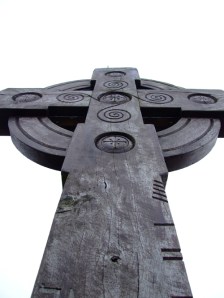
 Recent days (and nights) have seen me delving into the fascinating world of research on Celtic Christianity, helped along by a bottle of Laphroaig, the able Ian Bradley, James Mackey, Noel Dermot O’Donoghue, Oliver Davies, John MacLeod, Donald Meek, and the delectably fun Adomnán of Iona. All the while, the assessment offered by J.R.R. Tolkien in his famous lecture on ‘English and Welsh’ (reprinted in The Monsters and the Critics and Other Essays) has been ringing true in my ears:
“To many, perhaps to most people outside the small company of the great scholars, past and present, ‘Celtic’ of any sort is, nonetheless, a magic bag, into which anything may be put, and out of which almost anything may come. Thus I read recently a review of a book by Sir Gavin de Beer, and, in what appeared to be a citation from the original, I noted the following opinion on the river-name Arar (Livy) and Araros (Polybius): ‘Now Arar derives from the Celtic root meaning running water which occurs also in many English river-names like Avon’. It is a strange world in which Avon and Araros can have the same ‘root’ (a vegetable analogy still much loved by the non-philological when being wise about words). Catching the lunatic infection, one’s mind runs on to the River Arrow, and even to arrowroot, to Ararat, and the descent into Avernus. Anything is possible in the fabulous Celtic twilight, which is not so much a twilight of the gods as of the reason”. (pp. 185–6).
 jasongoroncy.com
Great Tolkien quote!
LikeLike