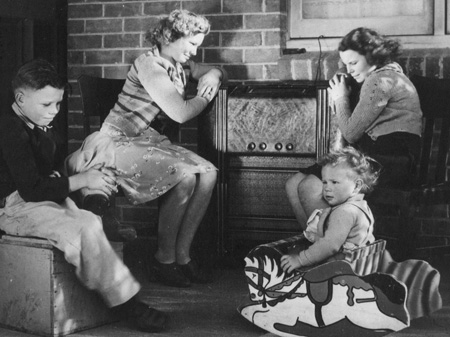
 ‘It is a weakness of printed literature that this reciprocity between writer and reader is difficult to maintain. The printing-press separates the writer from his audience and fosters cross-purposes between them. The organization of the literary profession and the “technique” of good writing, as that is understood among ourselves, consist to a great extent of methods for mitigating this evil; but the evil is only mitigated and not removed. It is intensified by every new mechanization of art. The reason why gramophone music is so unsatisfactory to any one accustomed to real music is not because the mechanical reproduction is bad – that would be easily compensated by the hearer’s imagination – but because the performers and the audience are out of touch. The audience is not collaborating, it is only overhearing. The same thing happens in the cinema, where collaboration as between author and producer is intense, but as between this unit and the audience non-existent. Performances on the wireless have the same defect. The consequence is that the gramophone, the cinema, and the wireless are perfectly serviceable as vehicles of amusement or of propaganda, for here the audience’s function is merely receptive and not concreative; but as vehicles of art they are subject to all the defects of the printing-press in an aggravated form. “Why”, one hears it asked, “should not the modern popular entertainment of the theatre, produce a new form of great art?” The answer is simple. In the Renaissance theatre collaboration between author and actors on the one hand, and audience on the other, was a lively reality. In the cinema it is impossible’. – Robin George Collingwood, The Principles of Art (Oxford: Oxford University Press, 1958), 323.
Tragically, the same critique may be laid against many churches. In fact, Collingwood’s words reminded me of Ben’s reflections on ‘a famous Sydney megachurch’ posted earlier this year.
 jasongoroncy.com
There is something about preaching which must be the unmediated connection between preacher and congregation. We need preaching without safety barriers, where we preachers run the risk of being punched in the face, where there may be real and unfriendly interaction. Every form of mediation of the word of God is a kind of safety barrier. When preaching has the written form of the sermon as its first focus then it has lost its way. A sermon really should be interruptible, so that the unmediated word of God comes through to people.
LikeLike
Great point Andrew – hope you get socked in the face a few times this week :-)
LikeLike
Hey Jason. Have you come across Stanley Cavell’s World Viewed: Reflections on the Ontology of Film? I am not competent enough to give a summary of the central argument of that brilliant and highly perplexing book, but it’s worth, I think, pointing out that one of the things that distinguishes its account of film that given by Collingwood, is that Cavell is a lot less sure that he knows what it is we are talking about when we talk about film, and what it is we are doing when we go to the cinema. Cavell’s question – why is it that our memories of films are like, are as intimate and personal and in some sense timeless, as our memories of dreams? – hints, at least, at the notion that film might be a much more mysterious thing, and the act of watching a film one that is far more difficult to describe, than Collingwood supposes.
On another note, did you know that MacKinnon, who is rumored to have gone to the cinema every night during his time as an Oxford don (1937-47), attended lectures by Collingwood in the early/mid-thirties?
LikeLike
Hi Andre,
I’ve neither read nor heard of Cavell’s book, so thanks for the heads up. Regarding MacKinnon, a fascinating fact. Any ideas of the kinds of films he watched? I’m so looking forward to reading your thesis. A likely finishing date?
LikeLike
Unfortunately, information about MacKinnon’s film-watching is very patchy. I do know that he watched Dark Victory on November 13, 1939. Earlier that year, he actually reviewed Algiers, the American version of the French film, Pépé le Moko, for The Oxford Magazine. In that review he also refers to the 1938 film Blockade. For some reason he (wrongly) attributes the direction of both Algiers and Blockade to Wilfrid Wagner, who actually produced both films, but I suppose they didn’t have IMDB back then. One of his former students told me that MacKinnon had an enormous knowledge of film, which I don’t doubt (especially given his exceptional memory). This is partially confirmed by his own listing of “film” as one of his interests (along with cats and walking) in Who’s Who. That is about all the concrete information I have right at the moment.
As far as the thesis goes, the deadline is the end of February. I’m very keen to read your work on Forsyth. Have you submitted yet?
LikeLike