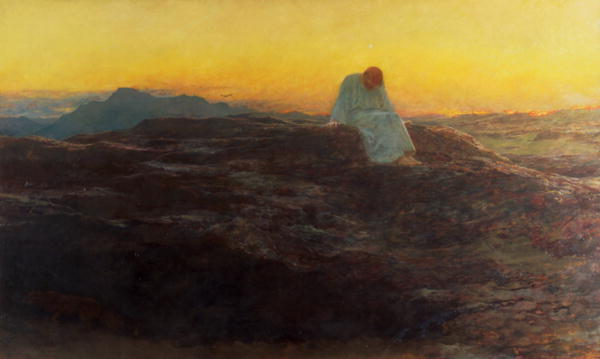
Briton Riviere, 'Christ in the Wilderness' (1898)
That obedient life which resisted temptation in both desert and garden culminated in an obedient death, a death concerned with holiness’ gracious victory. In Christ, God put himself onto the gallows of public shame – he descended into hell – from where he not only exposed himself to the actual onslaught and grasp of evil until it had done its worst, but confessed the holiness that undergirds not only his own Triune life, but all life.
So Forsyth:
Purity is shamed by human sin. Holiness carries it as a load, and carries it to its destruction. In the great desertion Christ could not feel Himself a sinner whom God rejects. For the sinner cannot carry sin; he collapses under it. Christ felt Himself treated as the sin which God recognises and repels by His very holiness. It covered and hid Him from God. He was made sin (not sinful, as I say). The holiness of God becomes our salvation not by slackness of demand but by completeness of judgment; not because He relaxes His demand, not because He spends less condemnation on sin, lets us off or lets sin off, or lets Christ off (“spared not”); but because in Christ judgment becomes finished and final … [The Work of Christ, 160]
Thus what is at stake in the two great temptations is far more than the destiny of this one man; it is the entire telos of creation itself, and God’s existence with it. In his humanity God declares the moral order of creation sanctified along with himself – Creator and creation are now one. Christ ‘sanctifies the whole lump of humanity by sanctifying Himself as the firstfruits’ [A.B. Bruce, The Humiliation of Christ In its Physical, Ethical and Official Aspects (Edinburgh: T&T Clark, 1895), 350].
 jasongoroncy.com