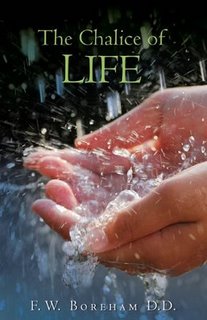
Geoff Pound, who served as principal of Whitley Theological College where I trained, and who is something of a FW Boreham devotee (and a great guy), has announced that a new Boreham book, The Chalice of Life, has just hit the printers. This is exciting news, and worthy of a plug. As a taster, here’s Geoff’s ‘Foreword’ to the book:
This book is a collection of five addresses that F W Boreham delivered on some major stages of life and this quintet is accompanied by two further essays in which the author develops the theme of life’s milestones.
Most of these essays were written soon after Boreham attained the particular milestone even though for his later lecture series he gave them a polish and wrote a new one for a stage he had not written about earlier.
It is good to reflect on Frank Boreham’s life at the time he reached each age as he draws much upon his own experience. At the age of thirty (1901) F W Boreham was married with one daughter, he was pastor of the Mosgiel Baptist church in New Zealand, contributor to the Taieri Advocate and the Otago Daily Times, editor of the New Zealand Baptist, and President of the Baptist Union. At the age of forty (1911) he had two more daughters, was pastor of the Hobart Baptist Tabernacle, he had authored several books and he was soon to begin his marathon commitment with the Hobart Mercury. At the age of fifty (1921) Boreham was pastor of the Armadale Baptist church in Melbourne, he had fathered a boy and another daughter in this last decade and his publishing ministry was in top gear. At the age of sixty (1931) F W Boreham was officially retired from pastoral ministry and was serving as a minister-at-large, across the denominations of the church and undertaking preaching and teaching tours overseas. At the age of seventy (1941), Dr Boreham had published his autobiography, in which he signaled that he had entered into the final stage of life. This was not entirely accurate as he churned out several more books and his weekly ministry at Scot’s Church was blossoming.
It is interesting to note that F W Boreham did not have an article on Life at Twenty, especially as he was fond of quoting Southey who said, “However long a person’s life, the first twenty years represent by far the biggest half of it.”[1] It is also significant that Boreham did not appear to write an article on Life at Eighty, even though he was still publishing books and preaching weekly.
F W Boreham remarks in one of these addresses that the one thing that each of these milestones has is life. F W Boreham was a self-confessed “lover of life.”[2] This theme pulsates through this book and in all his writing and preaching. In an essay on the coming of Spring Boreham reflects on the source of his love for life when saying, “I have learned that my quenchless longing for life is, after all, all unconsciously, a secret, unutterable yearning after God; for how can you conceive of life apart from Him?[3]
Throughout the pages of this volume one feels the sheer exuberance that Boreham had for life. He is possessed with a sense of wonder about the newness of each day:
“Half the fun of waking up in the morning is the feeling that you have come upon a day that the world has never seen before, a day that is certain to do things that no other day has ever done. Half the pleasure of welcoming a new-born baby is the absolute certainty that here you have a packet of amazing surprises….Here is novelty, originality, an infinity of bewildering possibility.[4]
It is Frank Boreham’s love of life that motivates his curiosity and his ministry to people:
“I have so thoroughly relished the little bit of life that was doled out to me that I find myself clamoring for all the lives that I can see….the same hunger underlies my passion for biography and even my fondness for the Bible. …Life has been so sweet to me that I like to mark the relish with which others tell their enjoyment of it.[5]
F W Boreham was very attentive to anniversaries and he kept a ‘birthday book’ or Personal Almanac in which he recorded special dates. He noted down each year the arrival of the first swallow[6] and the exact day that the elms around his house, “attired themselves in their new spring dresses.”[7] Many of his editorials commenced with reference to the birth or death of his subject. Two of his books contain the word ‘milestone’ in the title. His autobiography is a comprehensive record of the important dates of his life and family and it describes the way he remembered and celebrated the key events of his ministry.
The Chalice of Life is not so much about the exact ages as the general stages of life—their pitfalls and their possibilities. What then was Boreham’s favorite stage in life? This question is like asking him to decide which of his children was his favorite. Concerning his three churches he spoke with equal warmth and affection, even though he highlighted their different qualities. In a similar fashion and at the risk of being told that “all his swans were geese” Boreham writes with high commendation of each age and stage of life. What is happening is akin to the way he explained his growing love for Australia, “Life has a wonderful way of coaxing us into a frame of mind in which we not only become reconciled to our lot: we actually fall in love with it.”[8]
In the final two essays of this book, ‘So It’s Your Birthday!’ and ‘Life’s Landmarks’, we see the way F W Boreham is not merely registering dates in a diary or counting commemorations on a calendar. His approach is to greet each day with expectancy and to make the momentous decisions with which life confronts us. F W Boreham claimed that the greatest day of a person’s life was not their birthday, their wedding anniversary or the date of their death but, “The greatest day in a man’s life is the day on which he finds himself overwhelmed and bowed to earth by a sense of the greatness of God.”[9]
Enjoy this book and most importantly, drink deeply from “the chalice of life.”[10]
Dr. Geoff Pound.
Image: Front cover of The Chalice of Life, so beautifully created by Laura Zugzda.
P.S. F W Boreham’s son, Frank, told me that his wife Betty did most of the proof reading of his books. The ship would dock in Melbourne, the proofs would be delivered the next day and FWB and Betty would read and make the corrections before the ship left in a couple of days to return to England. When the first copy of each new book appeared FWB would take it warmly, kiss it and pass it to other members of the family for them to do the same. Producing Boreham books was a concern and a delight of the whole Boreham family.
Footnotes
[1] F W Boreham, My Pilgrimage (London: The Epworth Press, 1940), 91.
[2] F W Boreham, The Golden Milestone (London: Charles H. Kelly, 1915), 9
[3] F W Boreham, The Three Half-Moons (London: The Epworth Press, 1929), 125.
[4] F W Boreham, Faces in the Fire (London: The Epworth Press, 1916), 14.
[5] F W Boreham, On the Other Side of the Hill (London: The Epworth Press, 1917), 173.
[6] Boreham, The Golden Milestone, 34.
[7] F W Boreham, The Passing of John Broadbanks (London: The Epworth Press, 1936), 261.
[8] Boreham, My Pilgrimage, 137.
[9] F W Boreham, A Witch’s Brewing (London: The Epworth Press, 1932), 155.
[10] F W Boreham, A Bunch of Everlastings (London: The Epworth Press, 1920), 88.
 jasongoroncy.com
2 comments