Month: August 2006

Wrath Averted

Cascades of wrath descend on me.
Have done so all my life.
In the midst of life there was death—
Your hot breath upon me.
In the midst of my sin and guilt,
The fire of your love was my torture:
Cascades of wrath always upon me.

Now I cannot escape you,
Your eyes fixed upon me,
Warning of love that is a deeper torture
Than angry hate. Such hate you have not.
Your love is wrathful at my evil
And I cannot say you, ‘Nay!’
Nor raise a protest for my own protection.

If your wrath ceases then I am done.
I am a worm shrivelled, a creature burdened,
With no future love. I am lost
In the futility of your rejection,
Your refusal to honour me
With the fire of your wrath,
The cascades of burning zeal
That must tell me eternally
That you love this soul of mine.

How, Lord shall I escape?
How shall I emerge from the torment
Of your ceaseless love? How shall I regain
The pristine purity of spirit
In which you once created me?
Your wrath—my guilt—I surely know,
But how shall I escape, escape, escape?

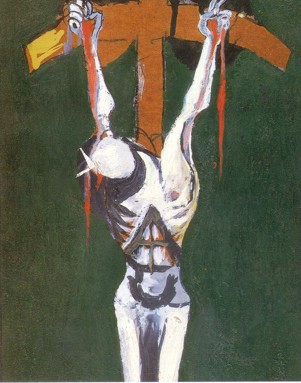
Here in my Cross you must come—
Here when the crowd mocks maniacally
And calls this the judgment of my Father
To strike in fury at my mind and heart—
You must come and hide within me.
Be crucified with me, be one with me
For I have myself wholly to be
One with you. Hide in me
For the wrath is now cascading
Out of His heart of love.
All guilt and pain, all sorrow, heaviness,
Confusion of spirit, and foulness of pollution–
These are His wrath you feel.
Contempt and broken pride, sheer loneliness
That knows no loving friend—
These are the things of wrath
That burn within your conscience.

Ah, strong cascades that empty from
The Eternal Bosom, fall upon
The Son He loves, the beloved Son.
He bears that wrath since he is one with me
And all my dread and sorrow cease
In the wrath of love that bears on him
In place of me. Ah, blessed love
Of Father and of Son that shelter me
From wrath that’s truly mine,
The wrath I should endure.

Who can endure such wrath, O Man?
Be still whilst I endure.
See all your sins, your guilts and shames
Dissolve in my love, that love that bears for you
Its holy due. Cascades of human blood
Or blood of beasts cannot erase the shame
Of all the human race. There is no power
But this the holy love that hides you full
Whilst wrath’s full fires expend themselves
Upon my holy Self. Crucified you are with me
And risen in peerless purity
For all eternity. That’s love!

(Geoffrey Bingham)

The real test of love

‘The real test of the love of man does not come until we love our enemies. The love of our enemy is only the love of our neighbour true to itself through everything … And there is only one source in the world to feed it and keep it alive – which is God’s love of His bitter enemies, and His grace to them in repaying their wrong by Himself atoning for them on the cross’ (P T Forysth, The Cruciality of the Cross, 166-7)

The hallucination of divine immutability

“If ever there was a miserable anthropomorphism, it is the hallucination of a divine immutability which rules out the possibility that God can let himself be conditioned in this or that way by his creature. God is certainly immutable. But he is immutable as the living God and in the mercy in which he espouses the cause of the creature. In distinction from the immovability of a supreme idol, his majesty, the glory of his omnipotence and sovereignty, consists in the fact that he can give to the requests of this creature a place in his will … God cannot be greater than he is in Jesus Christ, the Mediator between him and man … For this God is not only occasionally but essentially, not only possibly and in extraordinary cases but always, the God who hears the prayers of his own” Karl Barth, Church Dogmatics III/4, 109.

Keats on hope

When by my solitary hearth I sit,
When no fair dreams before my “mind’s eye” flit,
And the bare heath of life presents no bloom;
Sweet Hope, ethereal balm upon me shed,
And wave thy silver pinions o’er my head.

Whene’er I wander, at the fall of night,
Where woven boughs shut out the moon’s bright ray,
Should sad Despondency my musings fright,
And frown, to drive fair Cheerfulness away,
Peep with the moon-beams through the leafy roof,
And keep that fiend Despondence far aloof.

Should Disappointment, parent of Despair,
Strive for her son to seize my careless heart;
When, like a cloud, he sits upon the air,
Preparing on his spell-bound prey to dart:
Chase him away, sweet Hope, with visage bright,
And fright him as the morning frightens night!

Whene’er the fate of those I hold most dear
Tells to my fearful breast a tale of sorrow,
O bright-eyed Hope, my morbid fancy cheer;
Let me awhile thy sweetest comforts borrow:
Thy heaven-born radiance around me shed,
And wave thy silver pinions o’er my head!

Should e’er unhappy love my bosom pain,
From cruel parents, or relentless fair;
O let me think it is not quite in vain
To sigh out sonnets to the midnight air!
Sweet Hope, ethereal balm upon me shed,
And wave thy silver pinions o’er my head!

In the long vista of the years to roll,
Let me not see our country’s honour fade:
O let me see our land retain her soul,
Her pride, her freedom; and not freedom’s shade.
From thy bright eyes unusual brightness shed—
Beneath thy pinions canopy my head!

Let me not see the patriot’s high bequest,
Great Liberty! how great in plain attire!
With the base purple of a court oppress’d,
Bowing her head, and ready to expire:
But let me see thee stoop from heaven on wings
That fill the skies with silver glitterings!

And as, in sparkling majesty, a star
Gilds the bright summit of some gloomy cloud;
Brightening the half veil’d face of heaven afar:
So, when dark thoughts my boding spirit shroud,
Sweet Hope, celestial influence round me shed,

Waving thy silver pinions o’er my head.

Barth on art

‘It is a feeble view of art that isolates it as a sphere of its own for those who find it amusing. The word and command of God demand art, since it is art that sets us under the word of the new heaven and the new earth. Those who, in principle or out of indolence, want to evade the anticipatory creativity of aesthetics are certainly not good. Finally, in the proper sense, to be unaesthetic is to be immoral and disobedient.’ – Karl Barth, Ethics (ed. D. Braun; New York: Seabury Press, 1981), 510.

haunted … until Easter


‘Since my early teens, I have been haunted by the sense of the emptiness of worldly values and the futility of worldly achievements in the face of their inevitable annihilation in death and, eventually, the death of the solar system. The pasing years have placed more and more of what significance life held for me behind me. Nostalgia and resistance to change were sea-anchors intended to secure me against the wind-drift which carries everything toward the edge of the world. But Easter has begun to mean the presence of Yahweh in the face of that actuality to end all actualities. The resurrection has come to represent the treasuring up of the concrete achievments and actual values to which history has given birth, negotiating at the cost of death itself the impasse thrown up by the concrete failures and actual evils to which history has given birth. Under the sign of the name of Yahweh, Easter has led me no longer to resist time and not to a flight from this world but to a positive valuation of and commitment to this-worldly actions in the knowledge that they are “not in vain” in Yahweh.’ (J. Gerald Janzen)

God has a name

‘God has a name. The misery on this earth is nameless, the evil among men is nameless, for the powers of darkness love to be without a name. Nameless, anonymous letters, letters without signatures are usually vulgar. But God is no writer of anonymous letters; God puts His name to everything that He does, effects, and says; God has no need to fear the light of day. The Devil loves anonymity, but God has a name. He did not get this name by chance; in fact He did not receive it at all: He gave it to Himself because He wants to have a name. For him, name does not mean noise and smoke that cloud the splendour of Heaven; His name is His sign, the sign that shows that He is the true God; His name is His signature, so to speak, His monogram, His seal, His stamp (His trademark, if you will!) – whatever bears His stamp is God’s. God would certainly have had the power to be nameless; but because He loves clarity and hates obscurity He preferred not to be a nameless God’. – Walter Lüthi

Off to Prague

I’m off to Prague for the FEET Conference tomorrow where I will be presenting a paper on Forsyth and Ibsen and on why the Church needs the world. Should be fun. I’m looking forward to the discussion, the conference as a whole and, of course, seeing Prague. So I’ll be out of blogdom for a few days.

For those who are curious, the FEET Conference is not a conference for podiatrists, which, of course, would be fun … NOT. The FEET (Fellowship of European Evangelical Theologians) Conference is a biennial event and this year the theme is Reconciliation Vertical and Horizontal Dimensions. Leaflets can be downloaded here and a fuller programme here. Speakers include Henri Blocher, Pierre Berthoud, Herbert Klement, Torsten Uhlig, I. Howard Marshall, Ian Randall, Max Turner, Mark Seifrid, Stephen Holmes, Oliver Crisp, Jan Ligus, Pavel Hosek, Peter Kuzmic, Johannes Reimer, Sylvain Romerovski, Gie Vleugels, Jan Henzel, Mark Elliott, Peter Penner, and Johannes Reimer.